Sunday, 10 February 2013

asteroids - How can they tell no asteriods will hit earth in the next hundreds years?

A couple of points based on some basic orbital mechanics


They don't need to get a "good" view, like the clear, crisp photos of Pluto to see one coming. They only need to get a picture over time to calculate trajectory. The unclear snapshots work just fine to calculate if it'll hit us or miss us.


Also, an object as far as Mars at it's closest pass to earth, a bit over 1/2 AU, would still take a few months to reach earth if it's in solar orbit. Mostly we don't need to track anything as far out as Pluto, they can look much closer to the Earth and still have sufficient warming time. The hard part, is tracking things that approach from the Sun side, cause those are harder to see. That's why the Chelyabinsk meteor wasn't spotted. it was also on the small side, smaller than NASA is currently looking for.


The good news is that, we don't get struck by things that size very often. The Solar system is pretty enormous and pretty empty and pretty big strikes like that one are rare, like, maybe once a century.


Also, virtually all of the injuries from the Chelyabinsk meteor were from people who didn't know what to do. If you see a big fireball in the sky, it's human nature to watch it, but use some common sense. A space rock of that size will make a shock-wave that travels at roughly the speed of sound and the shock-wave can break windows, even knock over trees and buildings if it's big enough. You don't want to be standing in-front of a window when the shock wave its. Lay down next to a couch or under a table in case your building gets shaken and cover your ears. If everyone had done that, there would have been very few injuries. You only need to wait maybe 2 minutes or so to be on the safe side.


If you're in a car, stop, cause the shock-wave could knock down trees or debris in-front of you and stay in the car, cause that's safer than being outside. All told, the damage to buildings was tiny compared to natural disasters like Earthquakes, floods or volcanoes which happen to us several times a year. It's good that NASA is watching for this kind of thing, but it's also a pretty rare event.

Thursday, 7 February 2013

orbit - Do orbital resonances always form naturally?

If the question is "if I throw two planets to orbit a star at random direction, would they form an orbital resonance?" -- then in general, no. A resonance is an integral ratio (1/1, 2/1, 3/5, etc.) between the periods of motion of objects -- i.e., the ratio of their periods forms a rational number. Formally speaking the odds of getting a integral ratio (let alone a strong, low-order ratio, since those are the dynamically interesting ones) if you set the system up "randomly" should be infinitesimal, because irrational numbers are (infinitely) more abundant that rationals.


However, if the orbits of one or both of the planets can change over time, then the ratio between their periods changes, and they can end up in a resonance. (Which is maybe answering the title question.) How often this happens depends on whether the planets happen to start near a strong resonance, and on how rapidly the orbits change. (If the orbit of a planet changes slowly, then it won't encounter new resonances very often; on the other hand, rapid orbital change can overwhelm the effect of weak resonances, so that the planet passes through the resonance without being caught.)


For example, it's thought that Neptune and Pluto were originally not in resonance; but the gradual outward migrations of Neptune (due to various gravitational encounters between planetesimals and the giant planets) changed its orbital period and meant that eventually it reached 2/3 resonance with Pluto, and Pluto was "captured" by the resonance, after which it stayed in resonance with Neptune.


The vast majority of objects in the Solar System are not in resonance with anything else, which is perhaps another way of answering your question. (I.e., in practice it doesn't happen very often.)

Wednesday, 6 February 2013

How many arms does the Milky Way galaxy have?

This is actually a really, really tough question.


Look at this diagram:


Purple: Norma Arm and Outer Arm.
Green: Scutum-Centaurus Arm
Pink: Carina-Sagittarius Arm
Cyan: 3 kpc Arm and Perseus Arm


So we can slightly modify this picture by saying that there are four arms, and calling them by the following names:


Norma-Outer Arm


This arm has one end at the center of the Milky Way; this end is called the Norma Arm. It's actually quite small. However, as you continue outward along the lanes of gas, dust and stars, the Norma Arm becomes the - wait for it - Outer Arm.


Scutum-Centaurus/Crux-Scutum Arm


This arm also emanates from the center (well, duh!) and is distinguished by large numbers of clusters of red supergiants near the center (where it is referred to as the Scutum Arm) of the Milky Way. The Scutum-Sagittarius Arm is one of the Milky Way's two major arms.


Carina-Sagittarius Arm


The defining feature of this arm is that is has many H II regions, where ionized gas is plentiful. It is though that stars can form there. However, H II regions are also present in many other parts of the galaxy. Observations from the Spitzer Space Telescope seem to support these theories and prior observations.


The Spitzer results are, I think, very important for understanding our galaxy and the things in it. It confirmed the existence of all four arms, but also confirmed that the Norma-Outer Arm and Sagittarius Arm are relatively minor compared to the other two.


Near/Far 3 kpc Arm and Perseus Arm


The Near and Far 3 kpc Arms (which really are just one arm) are very close to the galactic center - about 3,000 parsecs (hence the name). The Far Arm was only discovered recently, while the Near Arm was first observed about 50 years ago. These two mini-arms are expanding outward at an enormous rate. The combined 3 kpc Arm then becomes the Perseus Arm, which extends out to about 3.5 times the distance from the center of the 3 kpc Arm. It is the other major spiral arm of the Milky Way.


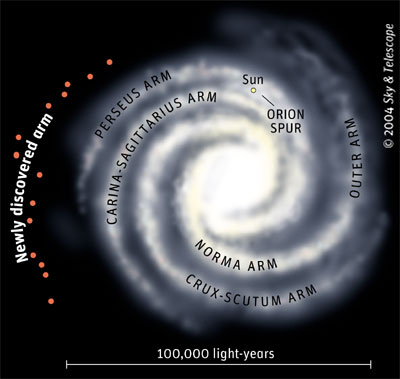
Okay, so that's simple enough. The Milky Way has four spiral arms, right? Well . . . sort of. The discovery of the "New Outer Arm"1 shook things up, because that would mean that the Norma-Outer Arm reaches nearly all the way around the Milky Way. That's strange and borderline inexplicable. Well, not really. But it's very interesting.


This image gives you a good idea of what it might look like:


By the way, someone at one point wondered, "Which are we in?" That, too, doesn't have a simple answer. Current observations state that we're in the Orion-Cygnus Arm, a/the midget of the galaxy (depending on whether or not there are other "mini-arms"). It's tiny - 1.1 kpc wide and 10 kpc long - and is between the Carina-Sagittarius Arm and the Perseus Arm.


Here's what it might look like:


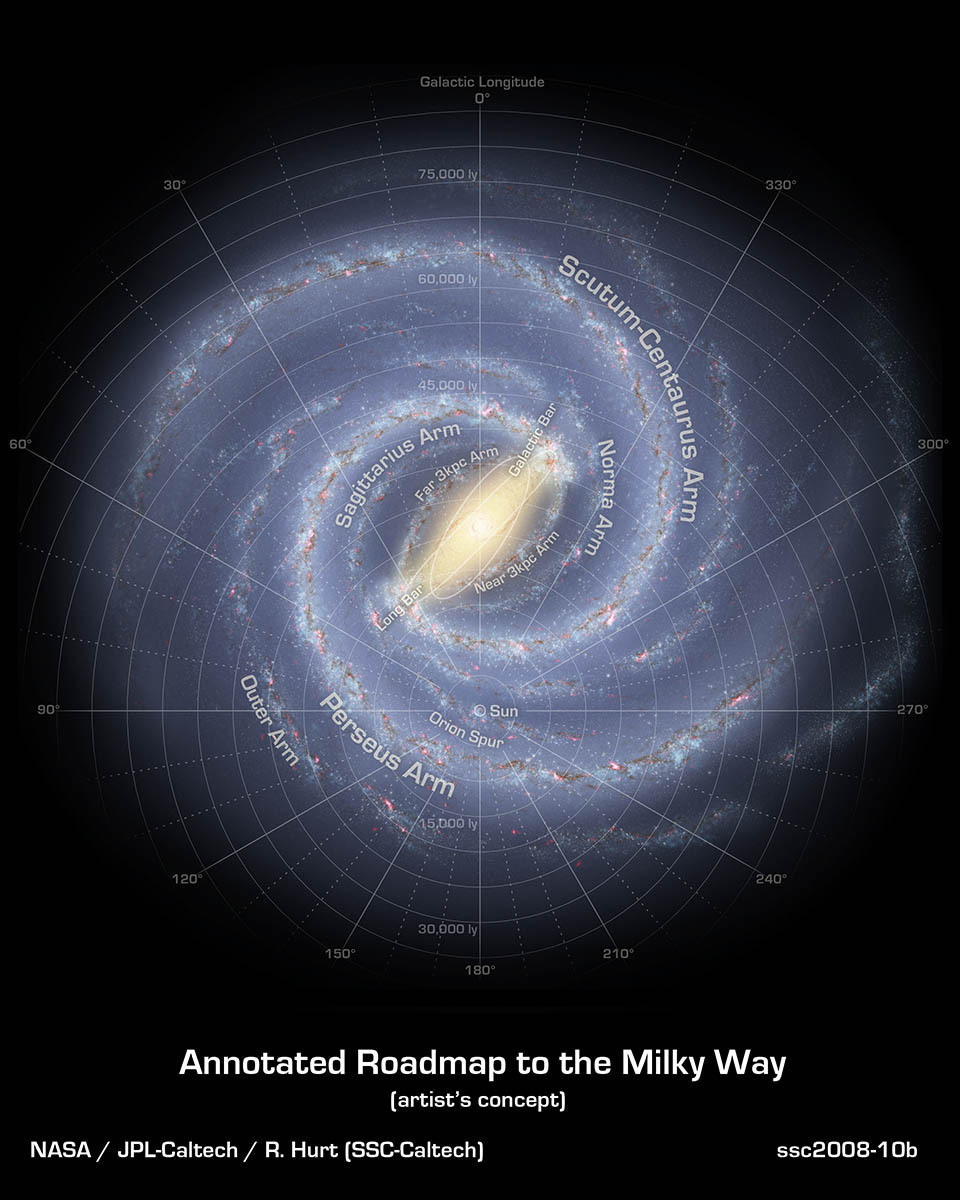
Putting it all together, Robert Hurt made a very famous impression of what the Milky Way might look like:


NASA gives a good explanation of it here.


If you want a good overview on everything, check out this blog post, which is reasonably well-sourced. Another post explains the four-arms-vs.-two-arms issue:


Like the proverbial blind men describing an elephant, the two groups of scientists are examining very different parts of the Milky Way. The Spitzer study detected hot objects visible in infrared. The CfA study used radio telescopes which can also detect colder objects such as supernova remnants, very young star formation regions and huge clouds of hydrogen gas. So it seems as though the older established star formation regions are mostly concentrated in two spiral arms, but that the very new star formation regions and the hydrogen clouds from which they form are also developing in two additional arms.


If you were hovering above the Milky Way in a spacecraft using binoculars or a regular optical telescope, you would see two main arms. But if you also had a radio telescope with you, it would detect two more.


The other group of scientists referred to here used the Very Long Baseline Array to image the Milky Way with radio waves; their observations support the four-main arms model.


So at the moment, I think the answer is four, though two arms are more distinct that the other two.


1Dammit, paywall! Thank goodness for arXiv.

Monday, 4 February 2013

black hole - Proof that Parallel Universes exist

Your radio information source is wrong.
The Large Hadron Collider has not discovered mini black holes.
When it comes back on line this spring, the LHC will begin looking for mini black holes: Large Hadron Collider Could Prove the Existence of Star Trek's Parallel Universe


Journalists do like their headlines, but the gist is this:


When the Large Hadron Collider is brought back online in the spring, researchers will be looking for the existence of mini black holes. These mini black holes would lend support to string theory, which posits that different dimensions and parallel universes are possible.


No miniholes yet, maybe never.

Sunday, 3 February 2013

star - How to calculate B-V colour index value percentage difference

$B-V$ corresponds to the base 10 logarithm of a flux ratio.


$$B-V = -2.5 log left(frac{f_B}{f_V}right)$$


So trying to guess what you are trying to calculate, it is the percentage change in the blue to visible flux ratio?


In which case the percentage change is
$$ p = frac{ 10^{-(B-V)_2/2.5} - 10^{-(B-V)_1/2.5}}{10^{-(B-V)_1/2.5}}times 100$$


A percentage change can of course be negative.

solar system - Why do (most of) the planets rotate counterclockwise, i.e. the same way the Sun does?

Referring to the mechanisms explaining the solar system formation and to the initial rotation of the gaseous cloud that collapsed, I understand easily why the planets orbit the Sun the same way this one rotate (say counterclockwise) but I can't figure out why this apply to planets rotation too. Thinking about that from Kepler's laws and angular momentum conservation point of view, I might conclude that the planets should rotate clockwise because the velocity of the particles that aggregated during the planets formation was higher closer to the Sun...


Apart from a short explanation, I would like to have a good reference from the literature if possible.


Edit, to make my reasoning more explicit: following Kepler's laws, the particles that aggregate on the "day side" of the proto-planets in the east-west direction relative to the ground are faster than the ones hitting on the "night side" in the west-east direction. If we add all of these contributions, the planets should rotate in the opposite direction relative to the initial cloud (i.e. relative to the actual Sun rotation). I guess something is wrong or missing there (to counterbalance the phenomenon I just described) but I can't see what it is...


New edit: References I found some published articles dealing with this kind of question but I don't have the time right now to read them carefully. If someone is motivated to do so, do not hesitate ;-) If I find the answer to my question amongst these papers, I will post it there later. Of course, you may need to use the network of an institution with a subscription to these editors to access them:


R.T. Giuli (1968a) in Icarus: http://www.sciencedirect.com/science/article/pii/0019103568900821


R.T. Giuli (1968b) in Icarus: http://www.sciencedirect.com/science/article/pii/0019103568900122


A.W. Harris (1977) in Icarus: http://www.sciencedirect.com/science/article/pii/0019103577900793


J.J. Lissauer, D.M. Kary (1991) in Icarus: http://www.sciencedirect.com/science/article/pii/001910359190145J

Friday, 1 February 2013

big bang theory - Is the time lapse considered when estimating the age of the universe?

As relativistic effects will cause clocks to run slower, a frame of reference must be chosen when considering the time of the "big bang". There is a natural and convenient choice of reference frame, based on the cosmic microwave background. The cosmic background appears to be extremely red-shifted light, indicating it is receding from us very fast, due to the expansion of the universe. If we choose a frame in which the CMB is receding equally fast in all directions, we have a convenient frame of reference. It is called the Comoving frame.


Now that we have a frame of reference, we can talk about time and distance in a way that all observers that share this frame can agree. In the comoving frame, the "big bang" occurred about 13.8 billion years ago.


To directly answer the question: The time measured is the time in the comoving frame and relativistic time dialations (time-lapse) are considered.