Sunday, 21 April 2013

celestial mechanics - In a binary star system, what relation determines the eccentricity of the three orbits (for $m_1$, $m_2$, and the reduced mass)?

Isn't it just conservation of momentum? Without any external forces, the centre of mass of the binary system must stay in the same place.


For example, imagine that you had a binary system, where one star had a circular orbit and the other, with equal mass, was eccentric. Clearly, as the orbits proceeded, the centre of mass, which is half way between the stars, would have a position which oscillates with time. But with no external forces applied to the binary system, this is forbidden by the conservation of linear momentum.

Thursday, 18 April 2013

temperature - Why is Rosetta's Comet so "warm"?

67P/Churyumov–Gerasimenko is actually not really warm when compared to these bodies.


You quoted figures for the minimum temperatures for Mercury and the Moon. Those are accurate but misleading. Both are for nighttime temperatures, taken from locations on the bodies that are facing away from the Sun. Daytime temperatures can skyrocket, to 427 degrees Celsius during the day on Mercury. The Moon can also get very hot during the day, although nowhere near as hot as on Mercury,


Looking at it like this, 67P/Churyumov–Gerasimenko's surface temperatures are pretty moderate, and nowhere near extreme. Rubin et al. (2015) suggest that it formed in extremely cold conditions - albeit ones not too extreme, for a comet.


The ESA has something related to say on the matter:


At these distances, the comet covered only a few pixels in the field of view and so it was not possible to determine the temperatures of individual features. But, using the sensor to collect infrared light emitted by the whole comet, scientists determined that its average surface temperature is about –70° Celsius.


The comet was roughly 555 million km from the Sun at the time — more than three times further away than Earth, meaning that sunlight is only about a tenth as bright.


Although –70° C may seem rather cold, it is some 20–30° C warmer than predicted for a comet at that distance covered exclusively in ice.


That said, evidence from the mission has made scientists think that an surface with a lot of dust may be the norm for comets.


67P/Churyumov–Gerasimenko isn't warmer or colder than the other bodies at this distance from the Sun. It's simply milder.


I would wager that the reason Mercury and the Moon can get so cold is because they don't really have atmospheres. Over the course of a day, Earth's atmosphere heats up a bit, and over night, it retains that heat, meaning that the surface can stay relatively warm. Mercury's atmosphere is extremely tenuous. The same goes for the Moon.


This might not be an issue, but one day on Mercury lasts 59 Earth days. One day on the Moon lasts for about one Earth month. This means that while there's time to trap some heat, there's also the same amount of time to lose it, and without an atmosphere, the heat gained is soon be lost.


67P/Churyumov–Gerasimenko also doesn't have an atmosphere to speak of, but it rotates quickly - rotating once every ~12.5 hours. This isn't necessarily perpendicular to the orbital plane, so not every part of it will face the Sun during a rotation, but it does mean that there's not as much time to lose heat.

luminosity - Conversion of magnitudes to Jansky and MAGPHYS?

I'm a bit puzzled and not an observer, so please bear with me if I'm being stupid here.


The code MAGPHYS specifies Jansky (Jy) as the input unit for flux through a filter (see Section 3.2.3 in the documentation). Meaning MAGPHYS wants me to use Jy as unit, when specify the total light of a whole galaxy in e.g. the SDSS-g band. But Jy is a unit of spectral density, i.e. W/m²/Hz. I would expect a flux as input unit when talking about the amont of light coming through a filter, i.e. in W/m² or in $L_odot$ (solar luminosity), so integrated over all frequencies that go through the filter and weighted by the filter response function.


If I have the absolute AB magnitude of a galaxy in the SDSS-g band, how do I convert it to Jy so that MAGPHYS will be happy?


I'm aware of:


$m_{text{AB}nu} = -2.5 log_{10} left(frac{f_{nu}}{3631text{Jy}}right) qquad text{or} qquad left(frac{f_{nu}}{text{Jy}}right) = 10^{-0.4 (m_{text{AB}nu} - 8.9)}$


But that is in one frequency, not a whole band.


Additionally, I have found the formula below in TOPCAT:


$left(frac{F}{text{Jy}}right) = 10^{left(23-0.4 (m_text{AB}+48.6)right)}$


Where does the 23 in the exponent come from?

Monday, 15 April 2013

What is driving the expansion of the Universe?

As far as I understood it, no one really knows. It is observable that the universe is expanding with increasing speed, therefore there has to be a form of energy driving it. We can meassure (or at least try) the amount of energy and find $Omega_lambda = 69.11%$ (see $lambda$CDM-Model)


To your questions:


1: I wouldn't imagine it as Big Bang momentum, for it is also changing. After the Big Bang, there was (or at least had to be, to make our comological model work) a period of inflation, meaning rapid expansion, which then slowed down again. I can't think of an explanation which includes some kind of finite momentum.


2: On small scales (speaking of galaxies), where densities are high, expansion doesn't act. Gravity is working against it.


3: It is responsible for the expansion. How exactly is not understood. (Little personal comment form my side. If a physicist calls something 'dark', it mostly likely means it is not understood)

Thursday, 11 April 2013

environment - Are we so sure global warming is a result of humans burning fossil fuels?

We know a lot about the sun. It isn't the main cause of global warming, as we can monitor exactly how much energy it is producing. The sun's output can fluctuate though, and we have yet to measure how badly this affects the climate.


So what is the main cause of global warming?


The main cause of global warming is emissions of C02 (carbon dioxide) into the atmosphere. C02 is odorless, colourless and non-toxic, however, it is the main cause of global warming. C02 is a greenhouse gas and can stay in our atmosphere for about 20 years.


C02 causes something called the greenhouse effect. The greenhouse effect is the idea that long wave energy which is meant to go back to space, doesn't go back to space, and is instead captured by greenhouse gases such as C02. This causes lots of heat that should go off into space to be trapped inside the earth's atmosphere causing your temperature to rise.


Are there any other greenhouse gases?


Other greenhouse gases do exist, carbon dioxide is just the main one that causes the global warming. Other greenhouse gases include water vapor, methane, nitrous oxide and ozone.


Does global warming happen only on Earth?


Global warming happens all over the solar system, planets like venus have many greenhouses gases in their atmosphere too, infact, on venus greenhouse gases alone make the planet 465 degrees celsius hot, which is way over the boiling point of water - 100 degrees celsius.


Do I disagree?


Yes, as there is too little evidence to prove that the sun fluctuates enough energy to gradually increase our climate dramatically, and we have also proven the effects of greenhouse gases in a planets atmosphere.

Monday, 8 April 2013

the sun - Is the Sun slightly blue in the center? - Wavelength-dependent limb darkening of the Sun

I've slightly modified the title to try to attract some attention. If we call sunlight "white" and limb darkening is a result of seeing deeper at normal incidence and shallower at oblique incidence, then the center end edge of the solar disk viewed from earth should appear to have slightly different effective color temperatures, since the temperature is varying rapidly with depth.


I'd like to have an approximate expression for the wavelength-dependent limb darkening of the sun in the visible spectrum, either a relatively simple analytical expression that I can understand (with the appropriate coefficients for the sun) or just some linear images of the sun in various bands in the visible wavelengths so I can try to make one of my own.


This question received this helpful comment which links to here but honestly I can't make my way through that to a practical expression I can use. The Wikipedia article is not helping me much either, except for the image there. I plotted scans of RGB but by the time an image gets into the internet, things like sRGB and gamma mean it may not be linear.


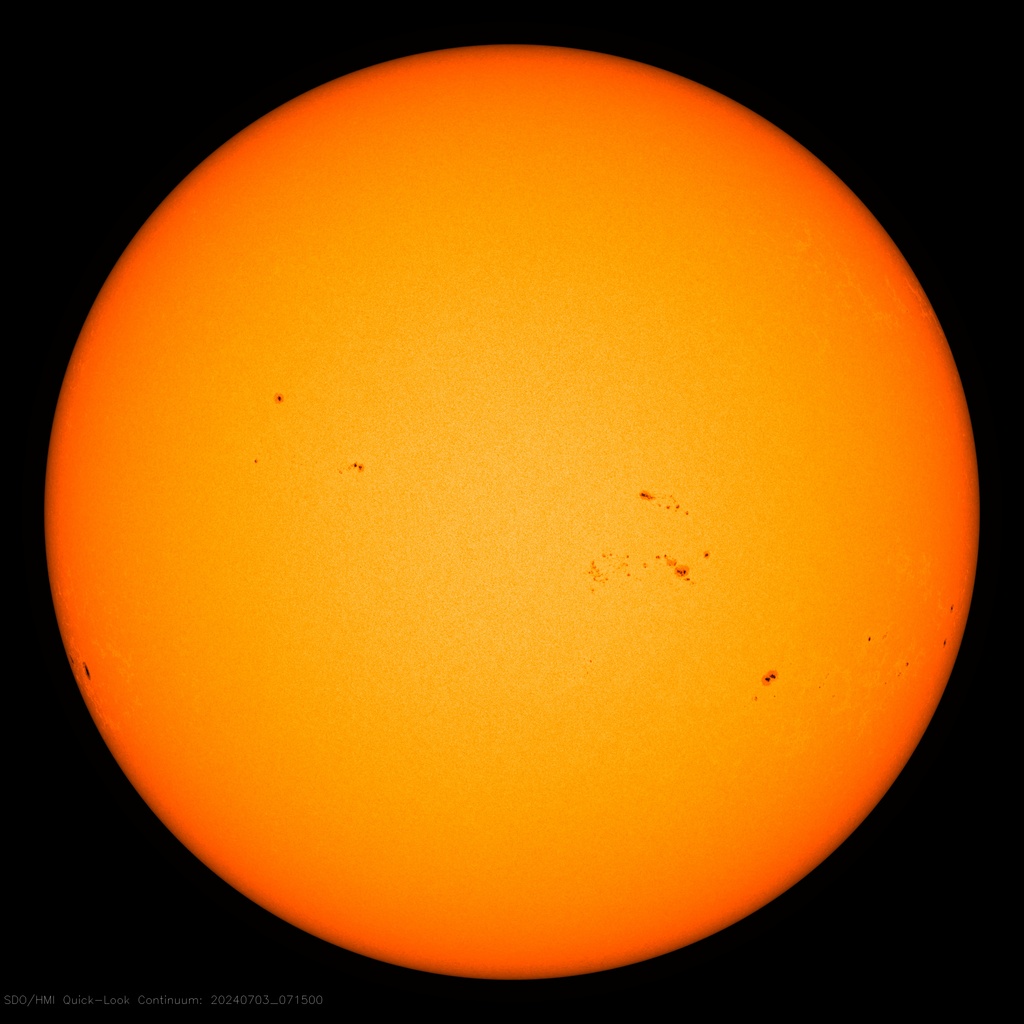
update: At the Solar Dynamics Observatory (SDO) website, I just found the image sdo.gsfc.nasa.gov/assets/img/latest/latest_1024_HMIIC.jpg. The color gradient of the limb darkening seems very similar to the Wikimedia image below. I've discovered that it is called a "colorized intensitygram" and the color gradient is purely artificial - the data is single channel intensity. The limb darkening is certainly real (compare to the artificially "flattented" display!)


From http://www.solarham.net/latest_imagery/hmi1.htm


enter image description here


I appreciate (the existence of) the complexities and intricacies of photon transport, instrumental effects, and color perception, but I am just starting to do astronomically correct animations, so please for right now, something imperfect, or not absolutely correct is good enough for me.


20 pixel wide averages of horizontal (-) and vertical (--) "scans" across the center of this 600x600 pixel image from here


note: It seems this is a somewhat futile example, as the image is likely to be a monochrome continuum image with false color!


enter image description here

Sunday, 7 April 2013

star - Is the sun too small to self-ignite?

Stan has essentially answered this in his comment, which I will attempt to spell out a little more laboriously.


The significant majority of our Sun's energy output comes from the proton-proton chain. This was advocated by Eddington back in the 1920's, but at that time your basic concern was a very real and major problem. Objects with like electrical charges repel each other. In particular, protons will repel other protons since all protons have a positive charge. What they knew of the sun then indicated that the core was far too cold for protons to overcome this repulsion—at least not even remotely close to the rate that was obviously necessary to produce a brightly shining sun.


With the development of quantum mechanics it was determined that a process known as quantum tunneling would give two protons a non-zero probability of "overcoming" this repulsion. But not in the sense of they just suddenly gain enough energy (hence why "overcoming" is in quotations). Instead, in the sense that the "fused together" state has the same energy as the "just about to repel each other before fusion can occur" state, and they just randomly switched from the latter to the former, despite every intermediate stage between the two of them requiring more energy than is available. That this is possible is one of the many non-intuitive features of quantum mechanics, and I think it would be beyond the scope of this question (and site) to try to get much more precise.


Still, even this failed to explain why our sun was very obviously fusing atoms to the extent that it was. If you fuse two protons together, you are left with an incredibly unstable state: the diproton. As soon as one of these forms it pretty much immediately breaks up into two distinct protons.


In the late 30's Hans Bethe (a man who eventually won the Nobel prize and was a part of the Los Alamos team that developed the atom bomb) proposed that yet another random quantum mechanical event would save the day: beta decay, a feature of the recently discovered fundamental force known as the weak force. In this situation one of the protons in the diproton undergoes a beta decay into a neutron before the diproton separates, at which point you have a stable deuterium nucleus: one proton, and one neutron.


That so many unlikely events have to occur for two protons to produce one deuterium is the reason why the sun's lifetime is approximately 10 billion years. That the sun shines as bright as it does is, as you suggest, a sheer numbers game: there are truly prodigious numbers of protons in the sun's core, so even though the proton-proton chain is really unlikely, we have so very many chances at it that there is a great many successful fusion events.


Basically every other stellar fusion reaction proceeds much more rapidly than those that produce deuterium. You may be familiar with the hydrogen bomb, which fuses its fuel very rapidly. One of the key differences (and there are many) between the hydrogen bomb and a star like our sun is that the bomb is fusing together deuterium (and tritium) into helium, and is not using the proton-proton chain. Stars have to produce large supplies of deuterium directly, and this is a lengthy process that consumes roughly 90% of a star's life—even for very massive stars, whose lifespans are orders of magnitude shorter than our Sun's.


(Note that very massive stars are rather more complicated beasts, in fact, but this is again beyond the scope of this question)